Former workers petition anti-graft agency to join $120m fraud investigation as they await National Assembly committee report
Former workers of the defunct Jos Steel Rolling Company in Plateau State have expressed renewed hope following the arrest of the Chairman of Zuma Steel West Africa Limited, Dr. Innocent Ozoemena Ezuma, by the Economic and Financial Crimes Commission (EFCC) over alleged fraud involving more than $120 million.
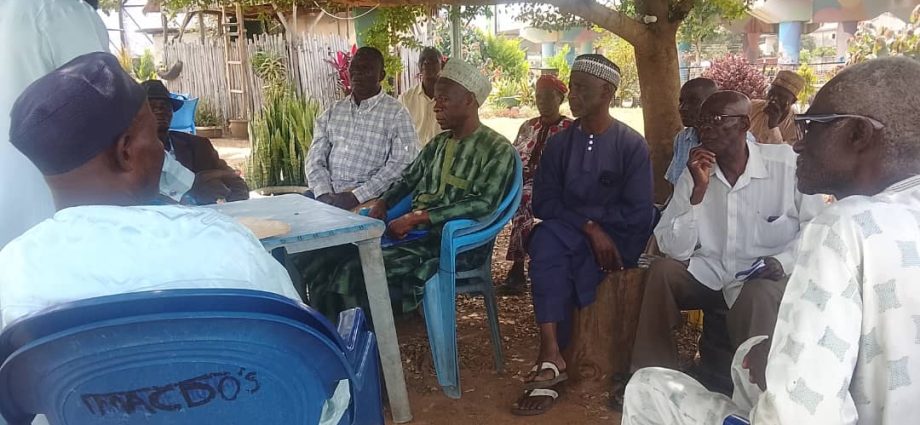
The workers, some of whom said they had spent nearly two decades without receiving their salaries and entitlements, held an emergency meeting in Jos on Wednesday, October 21, 2026, to discuss the development and review the status of their longstanding petition against Ezuma and his company.
The meeting was attended by more than 30 former employees, as well as widows and orphans of deceased workers who were affected by the prolonged dispute.
The former employees said the arrest had rekindled their hope for justice after years of alleged abandonment, unpaid salaries, disputes over staff accommodation and unsuccessful attempts to secure redress.
Speaking at the meeting, the workers’ leader and lead petitioner, Mr. Danjuma Samuel Agbo, a former Public Relations Officer of the company, disclosed that their petition before the House of Representatives Committee on Public Petitions had been heard and concluded on September 30, 2026.
Agbo, who led the delegation to the National Assembly alongside their lead counsel, Hon. Solomon Dalung, Esq., said the workers were now awaiting the committee’s final report for presentation to the House for adoption and further legislative action.
The petition, titled Danjuma Samuel Agbo vs Dr. Innocent Ezuma and Zuma Steel West Africa Ltd, concerns allegations of abandonment, non-payment of salaries and entitlements spanning about 20 years, violation of a consent judgment and the forceful eviction of workers from their staff quarters.
According to documents presented by the petitioners, following the privatisation of Jos Steel Rolling Mill in 2006, Zuma Steel West Africa Limited issued appointment letters to former federal government employees.
The workers alleged that the company paid full salaries for approximately three months and half salaries for about eight months between July 2006 and March 2007 before directing them, through an internal circular, to remain at home until electricity supply stabilised.
They claimed the circular assured them that they remained employees of the company, but that the arrangement subsequently left them without salaries for nearly 19 years.
The former workers further alleged that, despite the continued non-payment of their salaries, the company issued quit notices to employees occupying its residential quarters, demanding rent payments in cash or requiring them to vacate the premises.
They maintained that their appointment letters provided for housing allowances to be deducted directly from their salaries.
Worker recounts alleged eviction despite court judgment
Agbo described his personal experience as particularly distressing, alleging that he was forcefully evicted from his accommodation and business premises despite complying with a court judgment.
He said Zuma Steel had taken him to court over his staff quarters, resulting in a consent judgment directing him to pay for both his staff apartment and a separate business premises he rented within the quarters.
According to him, he fully complied with the judgment and retained receipts as evidence of payment.
However, he alleged that his apartment and business premises were subsequently broken into and his belongings thrown out during the COVID-19 lockdown in 2020.
Another former employee, Mr. Nansoh G. Lar, reportedly challenged the company’s actions at the National Industrial Court, Jos Division.
In the case of Nansoh G. Lar vs Zuma Steel West Africa Ltd, Suit No. NICN/JOS/31/2017, judgment delivered on September 20, 2019, the court held that the employment relationship subsisted and awarded arrears, according to the workers.
Former employees welcome EFCC investigation
The workers described the EFCC’s arrest of Ezuma as a significant development in their quest for justice.
The anti-graft agency announced on October 20, 2026, that Ezuma, 57, had been arrested at his Abuja residence on October 19 over allegations that he defrauded a Ukrainian investor of more than $120 million between 2007 and 2015 in connection with mineral exploration and power projects that were allegedly not executed.
EFCC spokesperson Dele Oyewale reportedly confirmed that Ezuma remained in custody as investigations continued into allegations including advance-fee fraud, criminal breach of trust, criminal conversion, obtaining money under false pretences, theft and money laundering.
The commission is also reportedly examining allegations relating to the privatisation of Jos Steel Rolling Mill, alleged asset stripping, diversion of funds to companies and individuals linked to the businessman, including his children, and the non-payment of workers.
Reacting to the development, Mr. David Isaiah, who said he was among the first 55 employees recruited by the Federal Government and sent to Germany for training in May 1981, described the arrest as a welcome development.
Isaiah said he received an appointment letter from Zuma Steel in 2006, worked for about six months and was subsequently asked to remain at home.
“This is the best thing that can happen to Nigeria! I didn’t know that the current EFCC can work like this,” he said.
Similarly, Mr. Signor Ben, who was employed in 1982 and was among those who signed the first letter of complaint to Ezuma and the Federal Government in 2013, described his re-engagement by Zuma Steel as the beginning of years of hardship.
He alleged that workers were instructed to remain at home rather than seek employment elsewhere, while the company paid them half salaries for several months before stopping payments altogether.
Mr. Sani Baba, a mechanical engineer employed in 1983 who said he produced spare parts and maintained the mill’s production lines, also expressed hope that the investigation would bring relief to the affected workers.
Baba alleged that the company retained former employees to train new staff for several years but abandoned them after initially paying full and partial salaries.
“Since then, no kobo has been given to us and a lot of our colleagues have died from long suffering,” he said.
He added that a transparent investigation could strengthen foreign investors’ confidence in Nigeria by demonstrating that their investments would receive adequate protection.
Workers seek inclusion in $120m fraud investigation
At the end of the emergency meeting, the former employees signed a fresh supplementary petition to be filed through their counsel, Hon. Solomon Dalung, and Agbo.
The petition, identified as Supplementary Petition to EFCC/PET/HQR/1733/2026, seeks to have the workers recognised as victims and witnesses in the ongoing investigation into the alleged $120 million fraud.
They also urged the commission to consider their outstanding salaries and other entitlements when determining any restitution arising from the investigation.
Additionally, the petition called on the EFCC to protect the workers from further alleged harassment and eviction while investigations continue.
The former employees commended the House of Representatives Committee on Public Petitions for hearing their complaints and thanked President Bola Ahmed Tinubu for allowing anti-graft agencies to carry out their duties without interference.
They also praised the EFCC for its action against Ezuma, urging the commission to remain impartial and ensure that the investigation is not compromised.
The workers expressed hope that the ongoing proceedings would finally lead to the recovery of their outstanding entitlements and accountability over the circumstances surrounding the privatisation and subsequent operations of the steel company.
The allegations against Ezuma and Zuma Steel West Africa Limited remain subject to investigation and any applicable judicial proceedings. The arrest does not in itself establish guilt.